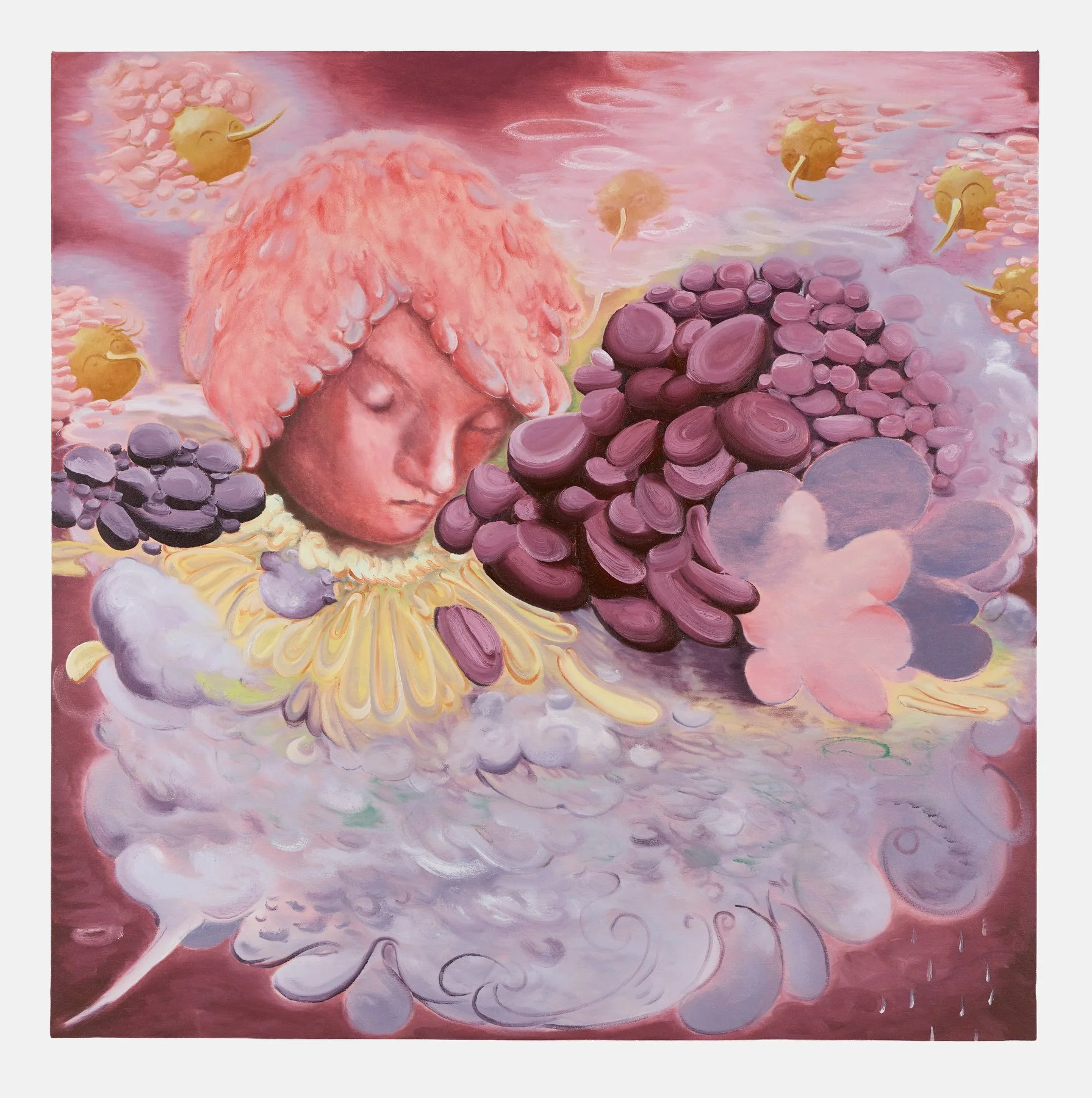
Singing ash and grit, 2026
oil on canvas
100 × 100 cm
Translating Dreams
Language is central to understanding the work of Dionisia Salas. Though her works are emboldened with feeling, language gives a framework to unpack the dichotomies jostling within them. The exhibition title, A fistful of light, demonstrates this tension perfectly. In this, the artist presents an impossibility: a bold, physical gesture trying to grasp an uncontainable force.
Salas has spent much of her life considering communication and meaning. She has had direct exposure to different languages in her life, with her family background from Spain and having lived in Berlin for several years. Familiar with the act of translating and mis-translating, she is also intrigued by local particularities in turns of phrase, aphorisms and slang that can at times be jarring or humorous. Like moving between languages, Salas’ work is an act of translation itself, carrying the logic of dreams across into colour and form. In her multi-faceted life as an artist, teacher and mother, vocabulary, phrases and understanding are a part of the everyday. These roles bring a consciousness of language to the fore, grappling with reason and meaning, and analysing sense and non-sense. Language provides an entry point to begin to understand Salas’ work which is full of intriguing contradictions and questions. Beauty, dreams and spirituality sit side by side with the abject, visceral, painful parts of life.
Salas’ work resists neat categorisation, oscillating between abstraction and representation, with both as important as the other. Throughout her practice, colour and form have been key to reading the work. What is exciting about this new body of work is that representation of the face and figure is taking a more central role. While still used with restraint, sometimes sporadically and other times obscured, these recognisable moments sit amongst the artist’s rich dreamworlds. The act of creating is intuitive and sometimes surprising. There is a sense of discovery within the making and viewing of the works, following impulses and “a sense of knowing but not necessarily understanding straight away”. 1 This is how language is first learnt, and it is how these works ask to be read.
The details found here are part of an ever-expanding visual language of form and line built throughout her oeuvre. Recurring phrases and punctuations of dream-like billowing breath, spheres, ears, lips and eyes form an alphabet by which to begin to understand connections and meaning. Less concerned with fixed meaning than with conveying feeling and evoking memories, the works invite viewers, like learning a language, to absorb and infer, experiencing an overall sense before honing in on specific phrases.
The gateway into this new series was a small group of watercolour works that the artist used to explore ideas, colours and details before expanding these thoughts into oil paintings. She speaks poetically of this process, of “pulling gestures out of previous works” and following their train of thought into new fields of vision. Recently, Salas has returned to a regular practice of life drawing, capturing the body in real time rather than from memory or references. While the face, limbs and bodily functions have always featured in her works through colour and shape, we now see faces and appendages rendered more fully in A fistful of light. The artist wanted to “communicate more overtly, but still with space for interpretation”. Something unlocked in these smaller watercolour works, which allowed the figure to confidently grow.
As the figure grew, so too did the dynamic of being watched. The heads that punctuate the new works are both observers and the observed. Watching the viewer, the maker and each other, they appear not in isolation, but in conversation. In Air will float, the breath of one figure becomes the eye of the next, and in Sandtime a cherub is quietly watching another person who appears in profile. Sandsight is where this phenomenon occurs most profoundly. In one moment a red-faced god is shadowed by an iridescent green doubled ghost, whose features are becoming distorted; in another section a contemplative Madonna-like face has a counterpart that appears as a loose, wispy, lilac spirit. Many of these occurrences can be read as explorations between ourselves and our inner worlds, or alter egos explored in different facets of life as a creator, teacher, mentor, friend or carer.
Alongside the figures, another punctuation appears in each of the works: the sphere. These can be read and defined in diverse ways, subject to their colour, size, rendering and juxtaposition. The artist is obsessed with circles, holes and spheres as a form that contains the whole meaning of the world in one symbol. It is the universe, an eye, a portal. Sandtime in particular depicts circles that are used interchangeably to communicate forms that look like nipples, pupils, thumbs or a cheek. The depiction of holes is used as a way to create dynamism and dimension in the paintings, protruding and receding, an opening to delve into or come out of, and as a way for us to enter or exit a work. This double entendre and ambiguity extends to various unidentifiable forms found throughout the work, which at moments have viewers asking, is it an ear or is it a bulge? Is it a dream or is it a thought? Is it an organ or is it a city?
The slippages between inside and outside, dream and thought, connect to the language of psychoanalysis, a useful reference to understand some of the actions and vignettes at play in the exhibition. We see figures doubled and mirrored, the unconscious and conscious at play, and dream states providing space to explore how we shape and interpret the world. Salas is part of a lineage of artists intrigued with psychoanalytic notions of the unconscious, surrealism and dreams in their work, including Hilma af Klint’s Paintings for the Temple and Louise Bourgeois’ Spider series, and Mirka Mora’s hand painted dolls, often made from bedsheets and pillowcases which she described as the material of dreams. 2 She shares distinct traits with these artists including embracing colour to convey emotion, the use of recurring symbols and the importance of materials as a foundation to imbue meaning. With an awareness of the weight and tradition of this art history, she develops a style and vernacular that is entirely her own.
Beyond this lineage, Salas is constantly reading about and looking at art. She draws inspiration and visual language from a vast array of sources including Botticelli, Philip Guston, Dana Schutz and cartoons. The artist engages with disparate practices, intrigued by how different artists approach depth, render form and treat the surface. This series gives a clear nod to the Renaissance, with the framing of works at times appearing like frescoes, the figures de-centred, heads peering from all angles and forms creating borders and internal zones for exploration and depth. The artist’s curiosity, knowledge and skill is on full display in A fistful of light, in wildly unexpected and delightful colour palettes, and in her ability to move easily from expansive abstraction into moments of highly rendered representation.
These recognisable forms and references sit within strong, surreal, pigmented landscapes where forms are sitting, disappearing, shrouded or hidden. Here colour becomes the ultimate language of feeling, going where representation alone cannot, conveying in particular moments joy, intimacy and grief.
Works like Air will float contain the artist’s distinct fleshy tones of pinks and reds, where we are looking at bodies and forms simultaneously from the outside and inside, seeing organs, toes, hair and breasts morph into clouds and smoke. Among the most adventurous coloured vistas is the work Sandsight. A band of glowing light in cobalt blue and neon yellow swirling through frames the work, with forms of burnt orange, soft lilac, fleshy pink and celadon green appearing throughout. The overall effect can be read as a contrast between the weight and expectation of reality, with the lightness and fluidity experienced in our dream or subconscious selves.
If Sandsight explores moments of illumination, a recent work Singing ash and grit explores a darker and quieter feeling. An angelic form appears at rest in a sea of purple, propped up by rich grape-like polyps and observed by a sea of small, floating, long-nosed animated spheres that appear like animated suns or a flock of inquisitive birds. It is not made clear if these spirits are a hostile crowd or watchful protectors.
While the exact meaning is obscured and open for interpretation, it is clear that conversation is happening within these works, with unspoken words and gestures conveyed between thed depicted human and anthropomorphic forms. There is also a strong but subtle thread of community contained in this new series. Air swallowed is painted on a canvas gifted by the late, great artist Vivienne Binns OAM (1940-2026), a close mentor and friend whose advice, humour, and company shaped Salas’ life in profound ways. Another friend, painter Joel Arthur, also gifted the artist a ‘power colour’, a tube of iridescent cobalt blue paint. This tube of paint had previously been gifted to Arthur by another artist, Bryan Foong, with the colour acting as a symbol of generosity and friendship, and a physical point of connection between a network of artists and artworks. Conversation and community have an important impact on Salas, and this is made real in the work itself, and the materials the works are made from which carry importance and meaning.
In A fistful of light Salas is asking an impossible question: can we grasp something that cannot be held? The works exist in a dream state and ask us to sense and intuit meaning before we can fully understand. Through a distinct visual dialect combining representation, colour and form, the artist has found a way to speak expansively about the world and how she lives within it, with joy, intimacy, sadness and loss intertwined. The light cannot be held, but it can be shared, connected, passed between figures, between artists and friends, and on to those of us looking.
Yvette Dal Pozzo
Director Goulburn Regional Gallery
1 All quotes from conversation with the artist, Walbanga Country/Braidwood, NSW, 15 August 2026.
2 Janine Burke and Lynne Cook, ‘Mirka Mora’, Farrago, April 26, 1974, p.11.